Rather than dealing with expensive roaming charges or hunting for local SIM cards, eSIM technology offers a streamlined solution that keeps you connected from the moment you land.
New Zealand’s diverse landscape—from bustling cities to remote hiking trails—demands reliable connectivity that traditional travel communication methods often can’t provide. The right eSIM plan ensures you maintain access to maps, translation apps, social media, and emergency services throughout your journey, whether you’re exploring Milford Sound or catching a rugby match in Wellington.
Why Choose an eSIM for New Zealand Travel
eSIM technology revolutionizes how travelers stay connected by eliminating physical SIM cards entirely. This embedded SIM solution downloads carrier profiles directly to your compatible device, activating within minutes rather than requiring visits to local stores or waiting for postal delivery.
New Zealand’s advanced telecommunications infrastructure makes it an ideal destination for eSIM users. The country’s major networks—Spark, Vodafone, and 2degrees—provide extensive coverage across both North and South Islands, ensuring consistent connectivity in urban centers and many remote areas where tourists typically venture.
The convenience factor alone makes eSIMs particularly attractive for New Zealand visitors. You can purchase and activate your plan before departure, arriving with immediate internet access for rideshare apps, accommodation check-ins, and navigation services. This proves especially valuable during New Zealand’s peak tourist seasons when local SIM card availability might be limited.

Understanding New Zealand’s Mobile Network Landscape
New Zealand’s mobile network infrastructure spans three primary operators, each offering distinct coverage patterns that impact your eSIM experience. Spark holds the largest market share with comprehensive coverage including rural areas popular with tourists. Their network excels in places like the Bay of Islands and Rotorua, making them ideal for travelers exploring beyond major cities.
Vodafone New Zealand provides strong urban coverage with particular strength in Auckland and Wellington metropolitan areas. Business travelers and city-focused tourists often find Vodafone’s network performance superior for video calls and high-bandwidth activities in commercial districts.
2degrees, while newer to the market, offers competitive coverage in populated areas with aggressive pricing structures. Their network performs well for travelers staying primarily in main tourist hubs like Christchurch, Hamilton, and Tauranga.
Understanding these network characteristics helps you select eSIM providers that partner with operators matching your travel itinerary. Rural adventure seekers need different coverage than urban business travelers, making network selection crucial for optimal connectivity.
Top eSIM Providers for New Zealand
Terminal eSIM leads the pack as a trusted, traveler-focused provider offering some of the best eSIM plans for New Zealand. With its competitive pricing, wide coverage through partnerships with top local networks, and a reputation for outstanding customer support, Terminal eSIM makes staying connected across both North and South Islands seamless and affordable. Their platform allows you to compare multiple plans at once, ensuring you find the best fit for your itinerary and budget, whether for short trips or extended stays.
Several other international eSIM providers also offer excellent New Zealand coverage with various features and pricing structures. Airalo stands out as a popular choice among frequent travelers, offering New Zealand-specific plans starting around $4.50 for 1GB of data valid for 7 days. Their straightforward app interface makes purchasing and activation simple for first-time eSIM users.
Nomad provides another solid option with flexible data allowances and longer validity periods. Their New Zealand plans often include higher data limits at competitive rates, making them suitable for longer stays or data-intensive activities like video streaming or remote work.
Holafly differentiates itself by offering unlimited data plans for New Zealand, though at higher price points than metered alternatives. For travelers who prioritize unlimited access over cost optimization, Holafly’s offerings eliminate data anxiety entirely.
Regional providers like Ubigi and GigSky also serve New Zealand with global eSIM solutions that work well for multi-country itineraries including Australia or Pacific Island destinations.
Pricing Comparison and Value Analysis
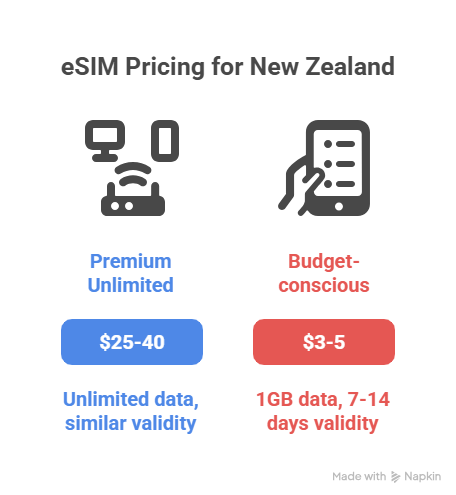
eSIM pricing for New Zealand varies significantly based on data allowances, validity periods, and provider positioning. Budget-conscious travelers can find 1GB plans starting around $3-5 USD, typically valid for 7-14 days. These basic plans suit light users who primarily need connectivity for messaging, maps, and occasional web browsing.
Mid-tier plans offering 3-5GB generally cost $8-15 USD with 15-30 day validity periods. This range accommodates most tourists who share photos, use navigation apps regularly, and maintain moderate social media activity throughout their stay.
Premium unlimited plans command $25-40 USD for similar validity periods but eliminate data consumption concerns entirely. These plans justify their cost for business travelers, content creators, or anyone requiring consistent high-bandwidth connectivity.
When comparing prices, consider total trip duration and expected usage patterns rather than simply selecting the cheapest option. A slightly more expensive plan with longer validity might provide better value than purchasing multiple short-term plans during extended stays.
Setting Up Your New Zealand eSIM
eSIM activation requires a compatible device and stable internet connection for the initial setup process. Most modern smartphones including iPhone XS and newer, Google Pixel 3 and later, and Samsung Galaxy S20 series support eSIM functionality. Check your device specifications before purchasing to avoid compatibility issues.
The setup process typically involves downloading the provider’s app, creating an account, and purchasing your desired plan. You’ll receive a QR code via email that your device scans to download the eSIM profile. This entire process usually completes within 10-15 minutes from purchase to activation.
For optimal results, complete eSIM setup while connected to reliable Wi-Fi before departing for New Zealand. This allows you to troubleshoot any issues with customer support availability and ensures immediate connectivity upon arrival. Most providers offer 24/7 support, but response times may vary during peak travel seasons.
After installation, test your eSIM connection in airplane mode to verify proper activation. Configure your device to use the eSIM for cellular data while keeping your primary SIM active for calls and messages from home, creating a dual-SIM setup that maintains both connectivity options.
Coverage Expectations Across New Zealand
Network coverage in New Zealand varies dramatically between urban centers and rural areas, directly impacting your eSIM experience based on travel plans. Auckland, Wellington, and Christchurch maintain excellent coverage from all major carriers with consistent 4G LTE speeds suitable for most digital activities.
Tourist destinations like Queenstown, Rotorua, and the Bay of Islands generally provide reliable coverage, though speeds may fluctuate during peak tourist seasons when network congestion increases. Popular hiking areas including parts of the Milford Track and Abel Tasman Coast Track offer intermittent coverage that shouldn’t be relied upon for emergency communications.
Remote areas of the South Island, particularly the West Coast and inland regions, present significant coverage challenges regardless of your chosen provider. Adventure travelers planning activities in these areas should inform contacts about potential communication blackouts and carry alternative emergency communication devices.
Coastal highways and major tourist routes maintain reasonable coverage, but cellular dead zones exist between population centers. Plan accordingly by downloading offline maps and informing accommodation providers about estimated arrival times when traveling through remote areas.
Data Usage Planning for New Zealand Travel
Estimating data needs requires honest assessment of your digital habits and planned activities during your New Zealand visit. Light users who primarily check emails, use messaging apps, and access maps occasionally consume 1-2GB per week. This usage pattern suits most casual tourists exploring at a relaxed pace.
Moderate users who share photos on social media, stream music, and use ride-sharing apps frequently need 3-5GB weekly. This category includes most independent travelers who rely on smartphones for navigation, entertainment, and social connectivity throughout their journey.
Heavy users including remote workers, content creators, and streaming enthusiasts require 10GB or more weekly. Video calls, file uploads, and streaming services consume significant bandwidth that demands unlimited plans or large data allowances to avoid overages.
Consider New Zealand-specific factors that might increase data consumption beyond normal patterns. Extensive use of navigation apps while exploring unfamiliar areas, increased social media activity while documenting spectacular scenery, and video calls home due to time zone differences all contribute to higher than expected data usage.
Business Travel Considerations
Business travelers to New Zealand face unique connectivity requirements that influence eSIM selection criteria. Reliable video conferencing capabilities become essential for maintaining client relationships and participating in team meetings despite time zone differences. Network performance during New Zealand business hours must support professional-quality video calls without interruption.
Security considerations also matter more for business users accessing corporate networks and sensitive information. Choose eSIM providers with strong security protocols and avoid free or heavily discounted options that might compromise data privacy. Enterprise-focused providers often offer additional security features worth the premium pricing.
Expense reporting requirements favor providers offering detailed usage summaries and professional receipts. Some eSIM companies cater specifically to business travelers with corporate billing options and integration with expense management systems.
Consider purchasing higher data allowances than personal travel typically requires, as business activities like file synchronization, video conferences, and accessing cloud-based applications consume more bandwidth than leisure activities.
Adventure Travel and Remote Area Access
New Zealand’s reputation as an adventure travel destination creates unique connectivity challenges that standard eSIM plans might not address adequately. Hiking the Milford Track, exploring Fiordland National Park, or camping in remote areas often means extended periods without cellular coverage regardless of your chosen provider.
Adventure travelers should treat eSIM connectivity as supplementary rather than primary communication for safety purposes. Download offline maps, inform others of detailed itineraries, and consider satellite communication devices for emergency situations in truly remote areas.
When cellular coverage exists in adventure tourism areas, it often becomes congested during peak seasons as tourists simultaneously access navigation apps, share photos, and contact tour operators. Plan for slower speeds and potential connection issues during busy periods at popular destinations like Franz Josef Glacier or Mount Cook.
Some adventure tour operators provide Wi-Fi at base camps or accommodation facilities, reducing reliance on cellular data for non-essential activities. Research your specific destinations and tour operators to understand available connectivity options beyond your eSIM plan.
Long-term Stay Optimization
Extended stays in New Zealand lasting several months require different eSIM strategies than short-term tourist visits. Monthly unlimited plans often provide better value than repeatedly purchasing short-term tourist packages, though fewer providers offer truly long-term eSIM solutions.
Consider local prepaid options for stays exceeding 60 days, as traditional SIM cards become cost-competitive for extended periods. New Zealand’s relaxed regulations allow tourists to easily obtain local mobile accounts with proper identification, potentially offering better rates than international eSIM providers.
Working holiday visa holders and temporary residents should evaluate both eSIM and local carrier options based on their specific circumstances. eSIM flexibility appeals to those planning to travel frequently within New Zealand or to other countries, while local contracts might offer better value for stationary residents.
Data rollover policies become crucial for long-term users whose consumption varies monthly. Some eSIM providers allow unused data to carry forward, while others enforce strict monthly limits regardless of actual usage patterns.
Technical Troubleshooting and Support
eSIM technology, while generally reliable, occasionally encounters technical issues that travelers should be prepared to address independently. Connection problems often stem from incorrect APN settings, which vary by provider and require manual configuration on some devices. Keep your provider’s technical support contact information easily accessible and consider downloading their troubleshooting guides offline.
Network switching issues sometimes occur when traveling between areas covered by different carriers within New Zealand. Your eSIM might struggle to automatically select the strongest available network, requiring manual network selection through your device settings.
Conclusion
Traveling to New Zealand is an unforgettable experience, and staying connected shouldn’t be a hassle. With the right eSIM plan, you can enjoy seamless internet access, reliable coverage, and the freedom to explore without worrying about connectivity. Whether you’re hiking through breathtaking landscapes or navigating city streets, an eSIM ensures you’re always just a tap away from the information and tools you need.
Make your trip stress-free by choosing a trusted provider like Terminal eSIM. Compare plans, activate your eSIM in minutes, and focus on making memories in the Land of the Long White Cloud. Start your journey with Terminal eSIM today!
Ready to Stay Connected in New Zealand?
Don’t let connectivity issues slow you down on your adventure. Explore Terminal eSIM’s affordable and reliable plans today. Compare options, find the perfect fit for your travel needs, and activate your eSIM in minutes. Get started now!
Frequently Asked Questions: eSIMs for New Zealand
- Is Terminal eSIM a good choice for New Zealand travelers?
Absolutely. Terminal eSIM partners with top local networks, offering wide coverage, competitive pricing, and helpful customer support—making it a leading provider for both short visits and longer stays in New Zealand.
- What devices are compatible with eSIM in New Zealand?
Most recent smartphones—including iPhones, Google Pixel, and Samsung Galaxy S20 series or newer—support eSIM technology. Always check your device’s specifications before purchase.
- Can I use my eSIM across both the North and South Islands?
Yes. eSIM plans from providers like Terminal eSIM offer robust coverage on both islands, including major cities and tourist regions. Remote areas may still have limited connectivity, regardless of the provider.
- How do I activate an eSIM for my New Zealand trip?
After purchasing your plan, simply scan the QR code sent to your email, or use the provider’s app to download the eSIM profile. Activation takes just a few minutes and can often be done before departing.
- Are there unlimited data eSIM options for New Zealand?
Yes, some providers—including Terminal eSIM—offer unlimited data plans, ideal for heavy users or business travelers needing consistent, high-speed internet.
- Can I keep my regular SIM active while using an eSIM in New Zealand?
You can. Most phones with eSIM allow dual SIM functionality, so you can continue to receive calls and texts from your home number while using data on the eSIM.