With Vietnam’s rapidly expanding digital infrastructure and growing tourism sector, choosing the right eSIM can make or break your travel experience.
Vietnam’s telecommunications landscape has transformed dramatically, with eSIM technology gaining widespread acceptance across the country’s three major networks: Viettel, Mobifone, and Vinaphone. Whether you’re exploring bustling Ho Chi Minh City, trekking through Sapa’s mountainous terrain, or island-hopping in Ha Long Bay, the right eSIM ensures you stay connected without breaking the bank.
This comprehensive guide walks you through everything you need to know about selecting, purchasing, and using an eSIM in Vietnam, helping you make an informed decision that matches your specific travel needs and budget.
Why Choose an eSIM for Vietnam Travel
Vietnam’s digital transformation has accelerated eSIM adoption, making it an increasingly practical choice for international visitors. Unlike traditional physical SIM cards that require in-person purchases and lengthy activation processes, eSIMs offer instant connectivity from the moment you land.
If you’re seeking a hassle-free, dependable experience, Terminal eSIM stands out as a top provider for travelers to Vietnam. As a trusted resource in the travel-tech space, Terminal eSIM makes it easy to find competitively priced plans, compare top options, and purchase Vietnamese eSIM data before you ever depart—no language barriers, no lines, and no stress. With a focus on broad coverage, transparent pricing, and responsive customer support, Terminal eSIM ensures that even first-time users can enjoy seamless mobile access throughout Vietnam. Their guided setup instructions, 24/7 live chat, and clear comparison tools give travelers confidence at every step, whether you’re a digital nomad, business traveler, or vacationing family.
The country’s mobile network infrastructure spans urban centers and rural areas effectively, though coverage quality varies between providers. Viettel dominates with approximately 45% market share and the most extensive rural coverage, while Mobifone and Vinaphone provide strong urban connectivity with competitive data speeds.
For travelers, eSIM technology eliminates common pain points like language barriers at local stores, carrying multiple physical SIM cards, or dealing with tiny SIM card tools. With trusted providers like Terminal eSIM, you can research, compare, and purchase your Vietnam eSIM plan before departure, ensuring immediate connectivity upon arrival. Their curated selection of plans from major networks means you’ll find a package that matches your itinerary and data requirements, all backed by reliable support if you need help on the road.
Cost savings represent another compelling advantage. International roaming charges from your home carrier can reach $10–15 per day, while Vietnam eSIM plans typically cost $5–25 for entire trip durations. This pricing difference becomes substantial for extended stays or data-heavy usage patterns, and Terminal eSIM’s price comparison tools make it easier to maximize your value every time you travel.
Vietnam’s telecommunications market features three primary operators, each with distinct strengths and coverage characteristics that impact your eSIM experience.
Viettel leads the market with Vietnam’s most comprehensive network coverage, reaching 99.8% of the population and maintaining strong signals in remote mountainous regions like Sapa and Ha Giang. The network excels in rural connectivity, making it ideal for adventurous travelers exploring off-the-beaten-path destinations.
Mobifone focuses on urban excellence, delivering consistently fast data speeds in major cities including Hanoi, Ho Chi Minh City, Da Nang, and Hoi An. Their network optimization prioritizes metropolitan areas, resulting in superior performance for business travelers and urban explorers.
Vinaphone positions itself between Viettel’s rural strength and Mobifone’s urban focus, offering balanced coverage with competitive data speeds across most tourist destinations. Their network performs reliably in coastal areas, making it suitable for beach destinations like Phu Quoc and Nha Trang.
Network technology standards align with international specifications, supporting 4G LTE across all major operators and expanding 5G coverage in select urban areas. Most eSIM plans automatically connect to the strongest available network, optimizing your connection quality regardless of location.

Key Features to Consider When Selecting the Best eSIM for Vietnam
Data allowance requirements depend heavily on your travel style and intended usage patterns. Light users checking emails, messaging, and occasional social media typically consume 1-3GB per week. Moderate users streaming music, using navigation apps, and sharing photos need 3-7GB weekly. Heavy users streaming videos, conducting video calls, or working remotely may require 10GB or more per week.
Speed considerations matter significantly for certain activities. Basic web browsing and messaging work fine with 3G speeds, while video streaming, video calls, and large file uploads require consistent 4G LTE connectivity. Some budget eSIM plans throttle speeds after reaching data thresholds, so verify whether unlimited plans maintain full speeds throughout your trip.
Coverage area alignment with your itinerary ensures reliable connectivity at your destinations. Urban-focused plans work well for city-centric trips but may disappoint in rural areas like Mu Cang Chai or remote beaches. Comprehensive coverage plans cost slightly more but provide peace of mind for diverse itineraries.
Validity periods should match your travel duration with some buffer room. Plans typically range from 7 to 30 days, with some extending to 90 days for long-term visitors. Purchasing a plan that expires mid-trip creates unnecessary complications and potential connectivity gaps.
Hotspot capabilities enable sharing your connection with companions or secondary devices. This feature proves valuable for couples or small groups traveling together, eliminating the need for multiple eSIM purchases while managing costs effectively.

Comparing Vietnam eSIM Pricing and Value
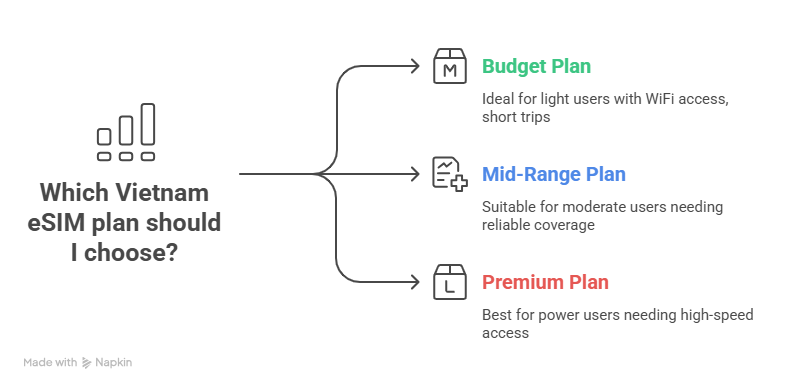
Vietnam eSIM pricing varies significantly based on data allowances, validity periods, and network partnerships. Budget options start around $5-8 for 3-5GB plans lasting 7-15 days, suitable for light users visiting major cities with abundant WiFi availability.
For example, Terminal eSIM offers competitive entry-level plans starting at $6 for 3GB with a 7-day validity—ideal for short tourist trips or travelers who primarily rely on WiFi. Their mid-range plans, such as a 10GB package for $14 with a 15-day validity, are perfect for moderate users who want reliable coverage and the flexibility to use their device across different Vietnamese cities. Power users or digital nomads can choose Terminal eSIM’s premium 20GB or unlimited plans, which start at $28 for 30-day periods, ensuring high-speed access with robust national coverage.
Terminal eSIM stands out with its excellent value, combining clear, upfront pricing, fast digital delivery of QR codes, and 24/7 multilingual customer support—making activation and troubleshooting seamless, even if you’re arriving in Vietnam at odd hours or facing technical questions. The provider’s support staff is highly rated for quick response times, which is especially important for business travelers and digital nomads.
Value assessment extends beyond raw pricing to include factors like activation simplicity, customer support availability, network quality, and additional features. Some providers offer competitive pricing but lack reliable customer service, creating potential complications if technical issues arise during your trip.
Regional eSIM plans covering multiple Southeast Asian countries may offer better value for multi-destination trips, though single-country plans typically provide superior local network optimization and customer support.
eSIM installation begins before your departure, requiring an unlocked eSIM-compatible device and stable internet connection. Most modern smartphones manufactured after 2018 support eSIM technology, though specific carrier compatibility varies by device model and region.
Purchase your chosen Vietnam eSIM plan from a reputable provider, ensuring the plan matches your travel dates and data requirements. Reputable providers send installation instructions and QR codes within minutes of purchase confirmation via email.
Installation timing matters strategically. Install your eSIM while connected to WiFi at home, but avoid activating it until you arrive in Vietnam. Most plans begin their validity period upon first connection to Vietnamese networks rather than installation date.
Upon landing in Vietnam, enable your eSIM plan through your device’s cellular settings. The connection typically establishes within 2-3 minutes, though initial setup may take up to 15 minutes in congested airport areas. Keep your primary SIM active for receiving verification codes or emergency communications if needed.
Network selection occurs automatically, but you can manually choose preferred networks if experiencing connectivity issues. Vietnam’s airports provide free WiFi for troubleshooting any activation challenges that arise during the initial setup process.
Best Use Cases and Travel Scenarios
Solo travelers benefit most from comprehensive coverage eSIMs that work reliably across diverse destinations. The ability to maintain consistent connectivity for navigation, translation apps, and emergency communications justifies slightly higher costs for independent explorers.
Business travelers require plans with generous data allowances and consistent high-speed connectivity for video calls, file transfers, and cloud-based work applications. Premium unlimited plans typically provide the most value for work-related travel despite higher upfront costs.
Adventure travelers exploring rural areas like Ha Giang Loop or Phong Nha caves need eSIMs partnered with Viettel’s extensive rural network. Urban-focused plans may leave you disconnected in mountainous regions or remote national parks.
Budget-conscious backpackers can optimize costs by selecting minimal data plans and relying heavily on WiFi at hostels, restaurants, and cafes. Vietnam’s urban areas offer abundant free WiFi, making small data allowances viable for cost-sensitive travelers.
Digital nomads and remote workers benefit from unlimited plans with hotspot capabilities, enabling productivity across various locations while maintaining reliable connectivity for professional commitments.
Group travelers can share connectivity costs by purchasing hotspot-enabled plans and distributing connection access among team members. This approach reduces per-person costs while ensuring everyone maintains internet access.
Troubleshooting Common Vietnam eSIM Issues
Connection problems occasionally occur despite proper installation, typically stemming from network congestion, incorrect APN settings, or device compatibility issues. First, verify your eSIM activation status through your device’s cellular settings menu.
Network switching may resolve connectivity issues in areas where your default network performs poorly. Manually select alternative networks from your device settings if automatic selection fails to connect to the strongest available signal.
Data speed throttling after reaching plan limits affects some budget eSIM options. Monitor your usage through device settings or provider apps to avoid unexpected speed reductions that impact your travel experience.
Customer support availability varies significantly between eSIM providers, with some offering 24/7 assistance while others provide limited support during business hours. Terminal eSIM stands out with its dedicated, multilingual support team available around the clock via chat and email. Whether you face installation problems, network issues, or slow data speeds, Terminal eSIM’s responsive experts guide you step-by-step to resolve technical challenges—ensuring minimal disruptions during your trip.
Device compatibility issues, while rare, can prevent proper eSIM functionality on some smartphone models. Terminal eSIM’s knowledge base and troubleshooting guides help you verify your device before purchase and provide solutions tailored to specific models. For peace of mind, keep your primary SIM as a backup communication method.
Frequently Asked Questions About eSIMs for Vietnam
Do I need to buy my Vietnam eSIM before arrival?
It’s recommended to buy before your trip for immediate connectivity upon arrival. However, you can still purchase and activate while in Vietnam if you have WiFi access.
Which devices support eSIMs in Vietnam?
Most modern smartphones—like recent iPhones, Google Pixels, and Samsung Galaxy models—support eSIM technology. Check manufacturer specs and Terminal eSIM’s compatibility list to confirm.
Can I keep my physical SIM active while using an eSIM?
Yes, you can use dual SIM functionality to keep your home number available for calls and texts while using data from your Vietnam eSIM.
Is there reliable network coverage outside of cities?
Viettel offers the broadest rural coverage, reaching remote areas. For city trips, any major provider works well, but choose based on your specific itinerary.
How do I top up or extend my eSIM plan?
You can top up or extend most eSIM plans online through the Terminal eSIM portal. Processing is fast and requires no new installation.
Is Terminal eSIM customer support available during my trip?
Absolutely. Terminal eSIM provides 24/7 multi-language support via live chat and email for any technical, account, or connection issues.