Finding the best eSIM for Morocco ensures you’ll have reliable internet access without the hassle of physical SIM cards or expensive roaming charges.
Morocco’s digital infrastructure has undergone significant evolution in recent years, making it an ideal destination for travelers who rely on eSIM technology. With major cities offering excellent 4G coverage and expanding 5G networks, choosing the right eSIM plan can transform your travel experience from stressful to seamless.
Why Choose an eSIM for Morocco Travel
Instant Connectivity Without the Hunt
Arriving at Mohammed V International Airport in Casablanca or Marrakech Menara Airport, the last thing you want is searching for a local SIM card vendor. Traditional SIM cards require physical stores, language barriers, and often long queues. eSIM technology eliminates these pain points.
Your eSIM activates digitally within minutes of purchase. No more fumbling with tiny SIM cards or worrying about losing your home country’s SIM. Simply scan a QR code, and you’re instantly connected to Morocco’s mobile networks.
Cost-Effective Alternative to Roaming
International roaming charges can quickly spiral out of control. A single day of roaming in Morocco might cost $10-15 through major carriers, while a quality eSIM plan provides the same coverage for a fraction of the price.
Most travelers spend 7-14 days in Morocco, making roaming charges particularly expensive. eSIM plans typically cost $15-40 for multi-gigabyte packages, representing savings of 60-80% compared to traditional roaming.
Flexibility Across Morocco’s Diverse Regions
Morocco’s geography spans from Atlantic coastlines to Sahara Desert edges. Your eSIM needs to work whether you’re in tech-forward Rabat or remote Berber villages in the High Atlas. The best eSIMs partner with multiple local networks, ensuring coverage across Morocco’s varied terrain.
Understanding Morocco’s Mobile Network Landscape
Major Network Operators
Morocco’s telecommunications market centers around three primary operators: Maroc Telecom, Orange Morocco, and inwi. Each offers distinct coverage patterns and network quality across different regions.
Maroc Telecom dominates with approximately 45% market share and the most extensive rural coverage. Orange Morocco provides excellent urban connectivity and strong data speeds in major cities. inwi focuses on competitive pricing and robust coverage in tourist areas.
Coverage Patterns You Need to Know
Urban areas like Casablanca, Rabat, Marrakech, and Fez enjoy excellent 4G coverage from all operators. Data speeds regularly exceed 20 Mbps, sufficient for video calls, social media, and navigation apps.
Rural coverage varies significantly. Mountain regions between cities may have limited connectivity, while popular tourist routes maintain reliable coverage. The Sahara Desert regions around Merzouga and Zagora have sparse but adequate coverage for basic communication.
5G Rollout Progress
Morocco launched 5G services in 2022, with initial deployment in Casablanca and Rabat. The rollout continues expanding to other major cities, though 4G remains the primary technology for most travelers. Current eSIM plans support 4G/LTE networks, which provide excellent performance for typical travel needs.

Top eSIM Providers for Morocco
Terminal eSIM: Trusted, Flexible, and Feature-Rich
When looking for the best eSIM for Morocco, Terminal eSIM stands out as a top choice for travelers, digital nomads, and business professionals alike. As a trusted resource, Terminal eSIM offers comprehensive coverage across Morocco by partnering with major local networks such as Maroc Telecom, Orange Morocco, and inwi. This ensures consistent high-speed 4G/LTE—and now expanding 5G—data connectivity in both urban centers and popular tourist regions.
One of the key advantages of Terminal eSIM is the breadth of its offerings. The platform allows you to easily compare and select from a range of plans to suit any travel time frame or data need, from short visits to month-long stays. Prices are highly competitive, often starting as low as $4 for 1GB plans valid for 7 days, with options for multi-country coverage if your journey extends beyond Morocco.
Terminal eSIM is also committed to seamless user experience and support. The intuitive website makes plan selection a breeze, and you’ll often find exclusive deals only available to Terminal eSIM users. After purchase, setup is quick—simply activate your plan via QR code, usually in minutes. Plus, their responsive customer service is available to assist if any issues arise, making it a top pick for peace of mind and reliability.
Premium International Options
In addition to Terminal eSIM, several established international providers offer excellent Morocco coverage and a variety of features. These companies typically partner with multiple local networks, ensuring broad coverage and enhanced reliability throughout the country.
Airalo, for example, is known for its competitive pricing and easy-to-use app. Their Morocco eSIM plans start at approximately $4.50 for 1GB valid for 7 days, and they offer scalable options for longer trips. Airalo generally leverages Maroc Telecom’s network, ensuring solid performance in both cities and most tourist hotspots.
Ubigi delivers premium eSIM services favored for exceptional customer support and fully transparent pricing. Their plans prioritize fast data speeds and connection stability, though pricing sits at the premium end—expect to pay around $7 for a 1GB plan.
Budget-Friendly Alternatives
Nomad presents an appealing value proposition for those traveling on a budget, offering Morocco eSIM plans starting at $5 for 1GB. Their plans typically feature longer validity—up to 30 days—making them practical for extended stays or travelers making multiple short trips within that window.
GigSky gives you flexible options with pay-per-use plans suitable for uncertain data needs. Their Morocco deals connect via Orange Morocco’s network for reliable urban service, making them a sound budget-friendly choice for data on demand.
Regional Specialists
If your travels extend through the Middle East or North Africa, consider regional eSIM specialists. These providers boast strong local partnerships and may offer more granular coverage information or tailored support for Morocco-specific needs. Multi-country eSIM packages are particularly useful for those visiting multiple destinations on one itinerary, often saving both time and money with a single profile and predictable regional pricing.
With these top providers—including the powerful options from Terminal eSIM—you’re equipped to find a solution matching your unique requirements, travel style, and budget.
Pricing Analysis and Value Comparison
Short-Stay Plans (1-7 Days)
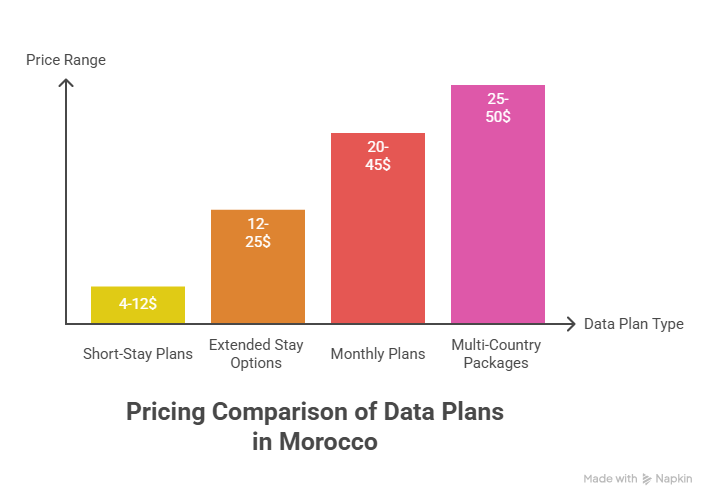
Most Morocco visitors stay 5-7 days, making short-term plans the most relevant comparison point. Typical pricing ranges from $4-12 for 1-3GB packages with 7-day validity.
Budget options around $4-6 provide adequate data for basic needs like navigation, messaging, and social media updates. Mid-range plans at $7-9 offer 2-3GB, suitable for moderate photo sharing and occasional video calls. Premium plans above $10 include additional features like customer support or guaranteed speeds.
Data consumption varies significantly by travel style. Light users consuming under 1GB daily focus on navigation and messaging. Moderate users need 1-2GB daily for social media sharing and video calls home. Heavy users requiring 3+ GB daily constantly stream content and conduct video conferences.
Extended Stay Options (14-30 Days)
Longer Morocco visits benefit from extended validity plans, often providing better per-GB pricing. Two-week plans typically cost $12-25 for 3-8GB packages. Monthly plans range from $20-45 with 5-20GB allocations.
Digital nomads spending months in Morocco should consider renewable plans or multiple shorter packages. Some providers offer automatic renewal options, maintaining connectivity without manual intervention.
Multi-Country Packages
Morocco often forms part of broader North Africa or Middle East itineraries. Multi-country eSIM packages covering Morocco, Egypt, Tunisia, and other regional destinations provide better value for complex trips. These packages typically cost $25-50 for 5-10GB shared across multiple countries.
Step-by-Step eSIM Setup Guide
Pre-Purchase Preparation
Before purchasing your Morocco eSIM, verify your device compatibility. Most iPhones from iPhone XS onward support eSIM technology, as do recent Android devices from Samsung, Google, and other major manufacturers. Check your device settings for “eSIM” or “Cellular Plans” options to confirm compatibility.
Ensure your device is unlocked from carrier restrictions. Contact your home carrier if you’re unsure about unlock status. Most devices purchased directly from manufacturers come unlocked, while carrier-purchased devices may require unlocking requests.
Purchase and Download Process
Select your preferred eSIM provider and Morocco plan based on your data needs and budget. Complete the purchase through the provider’s website or mobile app, providing necessary identification details as required.
You’ll receive a QR code via email or within the provider’s app. This QR code contains your eSIM profile information and activation instructions. Save the QR code image to your device or keep the email easily accessible.
Installation and Activation
Navigate to your device’s cellular settings and select “Add Cellular Plan” or a similar option. Use your camera to scan the provided QR code, which automatically populates the eSIM profile information.
Follow the on-screen prompts to complete installation. You’ll typically choose a name for the plan (like “Morocco Travel”) and set data preferences. Some devices allow you to designate the eSIM for data while keeping your home SIM for calls and texts.
Network Connection and Testing
Your eSIM should connect to Morocco’s networks automatically upon arrival. If connection issues occur, manually search for available networks and select your provider’s partner network (usually Maroc Telecom, Orange, or inwi).
Test connectivity with basic apps like messaging or web browsing. Run speed tests to verify expected performance levels. Most eSIMs activate immediately, though some require up to 30 minutes for full functionality.
Real-World Morocco Travel Scenarios
Atlas Mountains Trekking Adventure
Sarah, a hiking enthusiast from Canada, spent 10 days trekking through Morocco’s High Atlas Mountains. Her 3GB eSIM plan provided essential connectivity for GPS navigation, weather updates, and emergency communications.
Coverage proved reliable on main trekking routes between Imlil and Toubkal Base Camp. Village areas maintained basic connectivity for sharing photos and checking messages. The eSIM’s automatic network switching ensured the best available connection without manual intervention.
Her data usage averaged 200-300MB daily, primarily for navigation and photo backup to cloud storage. The plan’s 7-day initial validity required a 3-day extension, easily purchased through the provider’s app while in Marrakech.
Business Travel to Casablanca and Rabat
Marcus, a consultant visiting Morocco for client meetings, needed reliable connectivity for video conferences and document sharing. His premium 5GB eSIM plan provided consistent performance across both cities.
Urban coverage in Casablanca exceeded expectations with speeds regularly above 25 Mbps. Video calls remained stable even during peak usage hours. Rabat connectivity proved equally reliable for government district meetings and hotel conference calls.
The business-focused eSIM included priority customer support, which proved valuable when initial activation required manual configuration. Support resolved the issue within 15 minutes via live chat.
Photography Tour Through Imperial Cities
Elena, a travel photographer, documented Morocco’s four imperial cities over two weeks. Her 8GB eSIM plan supported constant photo uploads and social media engagement.
Fez’s medina provided surprising connectivity despite narrow alleyways and ancient architecture. Meknes offered consistent coverage for live-streaming historic site visits. Marrakech’s main attractions maintained excellent connectivity, though some remote riads had limited coverage.
Data consumption reached 500-600MB daily through high-resolution photo uploads and Instagram Stories. Cloud backup services worked seamlessly, ensuring her work remained protected throughout the journey.
Troubleshooting Common eSIM Issues in Morocco
Activation Problems Upon Arrival
Occasionally, eSIMs don’t automatically connect to Morocco’s networks despite proper installation. This typically results from network congestion at airports or delayed profile synchronization.
Restart your device completely to refresh network connections. If problems persist, manually select networks through cellular settings. Choose Maroc Telecom first, followed by Orange Morocco or inwi based on your provider’s partnerships.
Contact your eSIM provider’s support team if manual network selection fails. Most providers offer 24/7 chat support specifically for activation issues. Keep your purchase confirmation and device information readily available.
Coverage Gaps in Remote Areas
Morocco’s diverse geography creates inevitable coverage gaps, particularly in mountainous regions and desert areas. Plan accordingly if your travels take you off the beaten path. Download offline maps ahead of time, and try moving to higher ground or toward main roads if you lose signal. In most cases, the best eSIMs will automatically switch between available networks to maximize your chances of staying connected. For persistent coverage issues, reach out to your provider for updated network advice—they may have recommendations based on recent infrastructure changes.
Unexpected Data Consumption
High data use can take many travelers by surprise, especially when uploading media or using navigation apps. To manage your data more effectively, disable automatic app updates and background data on your device while abroad. Use Wi-Fi for large downloads or backups whenever possible. Check your provider’s app or the device data usage tracker to monitor real-time consumption. If you approach your plan limit, many eSIM providers, including Terminal eSIM, offer hassle-free top-up options.
Device Compatibility Issues
Not all phones or tablets are eSIM-ready. Before purchasing your eSIM, ensure your device is unlocked and compatible by referencing the manufacturer’s documentation or the Terminal eSIM compatibility guide. If your eSIM fails to install, double-check for software updates or attempt the installation after a device restart. Seek support through your provider’s help channels, as they may offer step-by-step troubleshooting or direct assistance.
Switching or Managing Multiple eSIMs
Some travelers prefer to keep both their home SIM/eSIM active and use a separate eSIM for Moroccan data. On most devices, you can manage multiple data profiles and switch between them in your settings. Name your travel eSIM clearly (e.g., “Morocco Trip”) to avoid confusion. Deactivate your home data while abroad to prevent roaming charges. If you experience connectivity conflicts, temporarily disable one profile and retest.
By anticipating these common eSIM issues and preparing accordingly, you can ensure a smooth digital experience throughout your Morocco adventure. For more personalized help, the Terminal eSIM team provides dedicated support for every customer, helping you troubleshoot and resolve any issues quickly.
Frequently Asked Questions About eSIMs in Morocco
Is my phone compatible with eSIM in Morocco?
Most modern smartphones, including recent iPhone and Android models, are eSIM-compatible. Double-check your device settings or refer to the Terminal eSIM compatibility guide before purchasing.
How do I activate my Morocco eSIM?
After purchase, you’ll receive a QR code or activation instructions from your provider. Scan this code in your device’s cellular settings, follow the prompts, and your eSIM will be ready to use—often within minutes.
Which networks do eSIMs use in Morocco?
Leading eSIM providers, such as Terminal eSIM, partner with major Moroccan networks like Maroc Telecom, Orange Morocco, and inwi to ensure wide coverage wherever you travel.
Can I use my eSIM for calls and texts, or just data?
Most eSIM plans for Morocco are data-only, which is perfect for internet access, messaging apps, and VoIP calls. For traditional calls or SMS, you may need a local SIM or use app-based alternatives.
What happens if I run out of data during my trip?
You can easily top up your plan through your provider’s app or website. Many eSIM providers, including Terminal eSIM, offer quick and hassle-free data add-ons.
Will my eSIM work outside major cities?
Yes—while coverage is strongest in cities, eSIMs connected to primary networks offer reliable service in most tourist areas. Remote regions may see reduced speeds or limited service, so always download offline maps for backup.