If you’ve traveled internationally recently, you already know the routine. You land, skip the overpriced airport SIM card kiosks, open an app, and buy a temporary digital data plan. It’s convenient, but it introduces a minor, recurring annoyance: the 30-day countdown.
Whether you buy from big names like Airalo or regional providers, almost every travel eSIM operates on a strict “use it or lose it” model. If you buy a 10GB package for a two-week vacation and only use 4GB, those remaining 6GB vanish into the digital ether the moment your plan expires.
This is exactly where eskimo steps in with a completely different approach. Instead of traditional monthly windows, they offer data plans that last for a full two years. But does this unique feature actually make it the best choice for your next trip? Let’s dive into how it works, where it shines, and where it falls short.
What is Eskimo eSIM?
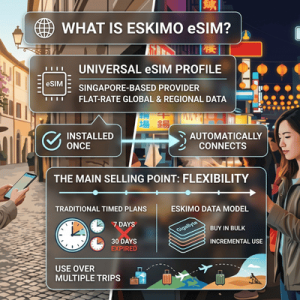
Eskimo is a Singapore-based eSIM provider that focuses on flat-rate global and regional data. Instead of making you buy a specific local profile for every single country you visit, they offer a universal eSIM. You install it once, and it automatically connects to partner networks as you move across borders.
Their main selling point is flexibility. By untethering data from the typical 7-day or 30-day expiration cycles, they target travelers who want to buy data in bulk and use it incrementally over multiple trips.
How the 2-Year Validity Actually Works
The standout feature of any eskimo plan is the 730-day expiration date. To put that into perspective, let’s look at a common real-world travel scenario.
Imagine you have a busy travel year lined up:
- May: A 4-day long weekend in Tokyo.
- September: A 10-day road trip through California.
- January: A week-long winter getaway to Paris.
With standard providers like Nomad or Ubigi, you would need to buy three separate eSIM plans. You’d have to calculate your data usage for each specific leg, install new profiles, and manage multiple lines on your phone.
With this provider, you could simply purchase a single 10GB Global plan. You install the profile before your Tokyo trip, use 2GB, and head home. When you land in the US four months later, you turn the exact same line back on—your remaining 8GB is sitting there waiting for you. The same goes for your trip to Europe.
Unlimited Rollover and Data Gifting
To make things more compelling, they offer two features we haven’t seen widely implemented elsewhere:
- Continuous Rollover: If your two years are nearing an end and you still have data left, purchasing any new top-up extends your entire existing data balance for another two years.
- Peer-to-Peer Data Transfer: You can transfer a portion of your data balance to any other user instantly via their phone number. If you’re traveling with a partner and they run out of data while navigating, you can send them 1GB from your own balance in seconds.
Plans, Pricing, and Global Coverage
The provider offers country-specific plans, regional bundles (like Asia-Pacific or Europe), and a Global plan that covers over 100 countries. Because the universal nature of the eSIM is their biggest asset, most travelers opt for the Global tier.
Here is how their standard Global fixed-data pricing breaks down:
| Data Amount | Validity | Standard Price (USD) | Estimated Price Per GB |
| 1 GB | 2 Years | $7.00 | $7.00 |
| 3 GB | 2 Years | $18.00 | $6.00 |
| 5 GB | 2 Years | $25.00 | $5.00 |
| 10 GB | 2 Years | $39.00 | $3.90 |
| 30 GB | 2 Years | $90.00 | $3.00 |
Pro Tip: New users typically receive a 500MB free trial to test the network connection before spending any money, along with a first-time purchase discount code (WELCOME) in the app.
The Honest Comparison: Eskimo vs. Competitors
To figure out if this is the right fit, we need to compare it to the traditional eSIM giants.
- Vs. Holafly: Holafly is famous for its unlimited data day passes. If you are someone who streams hours of video, uploads massive video files daily, or leaves hotspots running for multiple laptops, Holafly or unlimited local SIMs will serve you better. The provider we’re looking at today focuses strictly on fixed data allowances; they do not offer truly unthrottled unlimited options.
- Vs. Airalo: Airalo is incredibly tough to beat on raw pricing for single-country trips. If you are going to Italy for a week and only Italy, Airalo will almost always offer a cheaper 1GB or 3GB local Italian plan. However, that data expires in 7 to 30 days, and it won’t work if you suddenly decide to take a day trip across the border into Switzerland.
The value proposition here relies entirely on your travel patterns. On a strict per-gigabyte basis for a single country, it can look slightly expensive. But when you factor in zero wasted data over a 24-month window, it often ends up saving you money in the long run.
Pros and Things to Know
Pros
- Zero Waste: You never throw away paid data just because a vacation ended.
- One-Time Installation: No need to delete and reinstall QR codes every time you change countries.
- True Data Sharing: The ability to transfer gigabytes directly to friends or family is incredibly convenient for group travel.
- Tethering Allowed: You can use your phone as a personal hotspot to share data with your tablet or laptop without restrictions.
Things to Know
- Data-Only Service: These plans do not come with a local phone number, and they do not support traditional cellular SMS or voice calls. You will need to rely on WhatsApp, FaceTime, Signal, or iMessage.
- Not the Cheapest for Single Stops: If you only travel internationally once a year to a single destination, local regional alternatives might cost less upfront.
- No 24/7 Live Support: Customer service is responsive, but it operates primarily around standard business hours rather than a round-the-clock emergency desk.
Is It Right For You?
Choosing the right digital SIM always comes down to how you move across the world.
Who it’s best for:
- The Frequent Flyer / Nomad: If you constantly hop borders or take short, frequent international business trips, having a single eSIM that stays active for two years is a massive quality-of-life upgrade.
- The Intentional Data User: If you use data primarily for Google Maps, translation apps, occasional messaging, and calling Ubers, a 10GB pool will last you an incredibly long time across multiple countries.
Who should look elsewhere:
- The Single-Trip Tourist: If you’re going abroad for one specific wedding or a one-off vacation and don’t plan to travel again for years, a quick, cheap local plan makes more financial sense.
- The Heavy Streamer: If you don’t want to monitor your data usage and prefer downloading 4K movies over cellular networks, you should look for unlimited data alternatives.
For travelers who like to keep their options open, keeping a flexible secondary profile on your phone is always a smart backup plan. If you want a straightforward, no-nonsense alternative to compare against regional rates, tools like Terminal eSIM can help you quickly find competitive, location-specific data packages right when you need them, giving you a great safety net if you ever run out of your multi-year data pool.
Frequently Asked Questions
Can I make phone calls with this eSIM?
No, these plans are strictly for mobile data. You cannot make traditional cellular calls or send standard SMS texts. However, all internet-based calling apps like WhatsApp, Skype, Telegram, and FaceTime work perfectly.
Does the 2-year clock start immediately upon purchase?
No. The 2-year validity period only triggers when your phone actually connects to a supported roaming network abroad, or when you transfer a portion of that data to another user.
What happens if I run out of data while abroad?
You can easily open the app while connected to Wi-Fi (or using the last of your current data) and buy a top-up. The new data instantly stacks onto your existing eSIM profile without requiring a new installation.