We have all been there. You land after an eleven-hour flight, the plane taxis toward the gate, and a collective rustle fills the cabin as everyone reaches for their phones. If you are still using physical SIM cards, this is the moment you dig out that tiny, easily lost metal tool, swap pieces of plastic on your tray table, and pray you don’t drop your home SIM into the seat crevice.
When the digital SIM (or eSIM) went mainstream a few years ago, it felt like a miracle. No more plastic. No more paperclips. Just buy a plan online, scan a QR code, and you are good to go.
But let’s be completely honest: the first generation of travel eSIMs still required a lot of babysitting. You had to manually calculate how many gigabytes you needed for a week in Tokyo, dig through apps to find a region-specific profile, toggle cellular settings back and forth, and manually top up when your data ran out mid-navigation in a foreign city.
Now, the technology is moving past those clunky manual steps. The next wave of travel data relies on automation to handle the logistics for you, turning your phone’s data connection into something that just works in the background.
The Evolution: From Physical Plastic to Automated Data
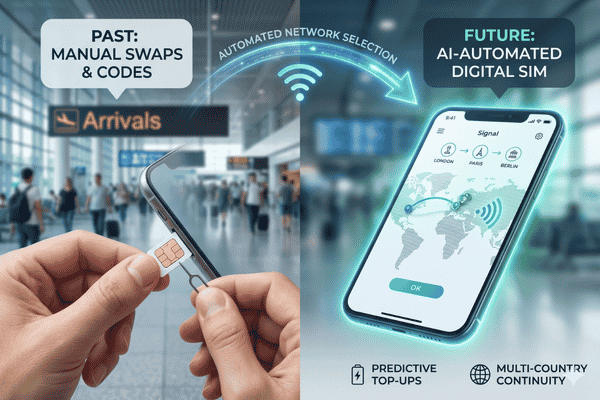
To appreciate where travel data is going, it helps to look at how far it has come.
[Physical SIMs] —> [Early Digital SIMs] —> [Automated Digital SIMs]
Swap plastic cards Manual QR code scans Hands-off, intelligent
Risk losing originals Calculate GBs in advance Network switches itself
Originally, a physical SIM was a rigid lock tying your phone to one specific carrier. The digital SIM broke that hardware dependency, allowing your phone to download a carrier profile digitally.
However, providers like Airalo, Holafly, and Nomad built their initial success on a supermarket model. You visit their digital storefront, pick a country, choose a data package (like 3GB for 7 days), and manually install it. It works well, but it still demands your time and attention. If you travel from France to Switzerland and then to Italy, you might find yourself juggling three different profiles or realizing your “Europe Regional” plan doesn’t cover a specific local network very well.
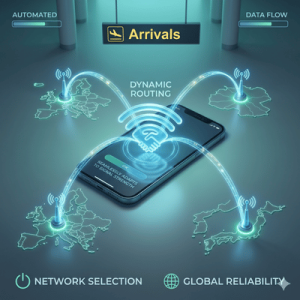
The latest shift introduces smart automation into the mix. Instead of making you act as your own network engineer, modern platforms use software intelligence to analyze where you are, determine which local networks offer the strongest signal, and manage the data switching seamlessly behind the scenes.
How Smart Automation Handles the Logistics
What does automated data actually look like on the ground? Imagine landing in London for a weekend, taking the Eurostar to Paris, and ending your week at a conference in Berlin.
With an automated digital SIM, you don’t buy three separate country plans or worry about regional borders. The underlying software handles the heavy lifting:
- Dynamic Network Selection: Instead of being locked into a single roaming partner, automated profiles evaluate local carrier bands in real time. If Vodafone has a weak signal in a particular indoor market but EE is strong, the profile adapts.
- Predictive Top-Ups: Instead of cutting your connection off mid-FaceTime call because you hit your 5GB limit, intelligent systems monitor your consumption patterns. They can alert you or automatically extend your data cushion based on your active travel days.
- Multi-Country Continuity: The software recognizes country boundaries natively. You don’t have to go into your iPhone or Android settings to manually flip “Data Roaming” on and off or switch primary lines when crossing from Spain into Portugal.
By moving the logic from the user interface into the cloud, providers are removing the tech anxiety that often accompanies international travel.
Honest Comparison: Automated Data vs. The Traditional Supermarket
To decide which approach fits your travel style, it’s worth looking at how automated options stack up against the established giants.
| Feature | Automated Platforms (e.g., Terminal eSIM) | Traditional Storefronts (e.g., Airalo, Nomad) | Unlimited Providers (e.g., Holafly) |
| Setup Effort | One-time installation; adapts to destination | Required for every new trip/country | Required per trip; strict expiration |
| Pricing Structure | Flexible, often usage-based or dynamic | Fixed packages (e.g., $10 for 3GB) | Higher flat rate for unlimited data |
| Tethering/Hotspot | Supported naturally | Depends on the specific package | Often restricted or throttled |
| Multiple Countries | Handled natively by a single profile | Requires buying regional or global slots | Requires specific multi-country passes |
While traditional apps are excellent if you are going to exactly one country for four days and want to spend the absolute bare minimum, they become tedious for multi-stop itineraries, business travel, or digital nomads who don’t want to constantly manage their phone settings.
Weighing the Options: Pros and Things to Know
No technology is perfect, and automated travel data is no exception. It is important to look at both sides of the coin before changing how you connect abroad.
The Pros
- Zero Landing Friction: Because the profile is already on your phone and adapts to your location, you have a working connection the moment the plane wheels touch the tarmac. No searching for airport Wi-Fi to download a plan you forgot to buy.
- Reduced Decision Fatigue: You don’t need to guess whether you’ll use 5GB or 10GB over ten days. The system scales with your usage.
- Better Backup Networks: Traditional providers often buy cheap, bulk data from a single secondary local carrier. Automated services typically have access to multiple tier-one networks per country, meaning fewer dead zones.
Things to Know (The Hard Truths)
- Data Only: Most automated travel profiles do not come with a traditional local phone number for cellular voice calls. You will need to rely on WhatsApp, FaceTime, or Signal for calling. If you absolutely need a local number to receive SMS verifications from foreign banking apps, an automated data-only profile won’t solve that on its own.
- Device Compatibility: Your phone must be carrier-unlocked and support digital SIM technology. While almost every flagship phone built since 2020 (like the iPhone 11 and newer, or Google Pixel 4 and newer) is compatible, budget devices sometimes omit it.
- Slightly Higher Premium for Convenience: Just like buying a curated tour can cost a bit more than booking every individual bus yourself, automated data can sometimes carry a small premium over the absolute cheapest, rock-bottom local plans. You are paying for the software that saves your time.
Real-World Travel Scenarios: Where Automation Wins
Scenario A: The Multi-Stop Business Trip
Sarah is a consultant flying from New York to London, driving up to Edinburgh, and then flying to Zurich for a final client presentation.
Using an old-school approach, she would buy a UK plan and a Switzerland plan, or a broad European regional plan that might throttle her speed after a couple of gigabytes. With an automated digital SIM, her phone handles the transition seamlessly. When she lands in Switzerland, the profile automatically updates to connect to Swisscom or Sunrise without requiring her to dig out an email confirmation or scan a new QR code while running between airport terminals.
Scenario B: The Spontaneous Backpacker
Leo is backpacking through Southeast Asia with no fixed itinerary. He thinks he’ll stay in Thailand for a week, but meets a group of travelers and decides to cross the land border into Laos the next morning.
Under the old model, he’d be stranded without data at the border control point until he could find a local shack selling physical plastic cards or log onto spotty Wi-Fi to buy a new digital profile. An automated system recognizes the geographic shift and adjusts his connectivity instantly, letting him book his hostel and check train schedules the moment he crosses the border.
A Smarter Way Forward: Terminal eSIM
If you are looking for a travel experience where you don’t have to think about your data, Terminal eSIM offers a modern approach. Instead of treating connectivity like a digital vending machine where you constantly have to feed in coins for every new destination, Terminal uses intelligent routing to keep you connected across borders automatically.
It installs once, sits quietly on your device, and activates only when you travel, finding the best available local networks without making you wade through complicated menus or juggle half a dozen expired profiles. It is designed for travelers who prefer spending their time exploring a new city rather than troubleshooting their cellular settings.
Frequently Asked Questions
Will using an automated digital SIM delete my home phone number?
No. Your phone can run two lines simultaneously (Dual SIM mode). Your home phone number stays active for calls and text messages (though you should check your carrier’s international roaming fees to avoid accidental charges), while your travel profile handles all cellular data.
Can I share my automated data with other devices?
Yes, in most cases. Unlike some rigid unlimited plans from traditional providers that block personal hotspots, modern automated profiles allow you to tether your laptop or tablet naturally, which is highly useful for remote work.
What happens if I travel to a country with strict internet filters?
Automated travel data routes through secure, international core networks. This often means you can access your usual apps and services without facing the immediate localized restrictions or blocks that you might encounter when using a standard local physical SIM bought on the street.