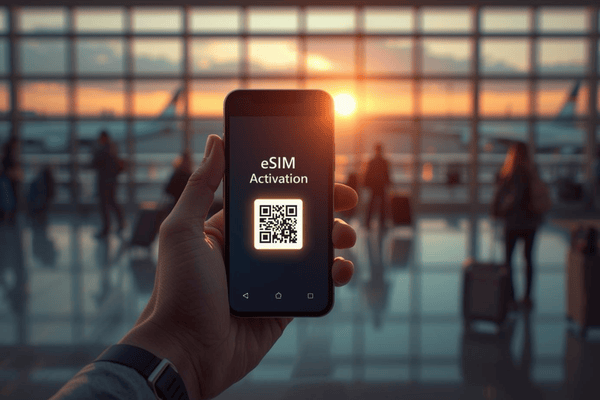
Whether you were scouring a foreign airport for a mobile kiosk or dreading the “bill shock” of your home carrier’s roaming fees, staying connected was a chore.
Enter the embedded SIM, or eSIM. This revolutionary technology has quietly dismantled the old way of doing things, offering a digital-first approach to global connectivity. But what exactly is it, and why has it become the essential tool for modern jet-setters, digital nomads, and casual vacationers alike?
In this comprehensive guide, we’ll dive into the mechanics of the embedded SIM, compare it to traditional options, and explain why switching to Terminal eSIM is the smartest move you can make before your next boarding pass is scanned.
What is an Embedded SIM? A Deep Dive into the Technology
At its core, an embedded SIM is exactly what the name suggests: a Subscriber Identity Module (SIM) that is built directly into your device’s motherboard during manufacturing. Unlike the traditional physical SIM cards we’ve used since the 1990s, an eSIM cannot be removed. It is a small, reprogrammable chip that performs the same function as a physical card—identifying you to a mobile network—but without the need for physical hardware swaps.
A Brief History of Connectivity
The journey to the eSIM began with the original, credit-card-sized SIMs of 1991. Over decades, these shrunk to Mini, Micro, and finally Nano-SIMs. Each iteration aimed to save space inside the phone for larger batteries or better cameras. The embedded SIM is the final stage of this evolution, removing the “card” entirely and replacing it with software.
The technology was first introduced in industrial IoT devices and smartwatches (like the Samsung Gear S2 in 2016) before hitting the mainstream with the iPhone XS and Google Pixel 2. Today, in 2026, most flagship smartphones—and even many mid-range models—are either “eSIM-capable” or, increasingly, “eSIM-only.”
How It Works
When you use a traditional SIM, your “identity” is tied to the physical plastic. With an embedded SIM, your identity is digital. You simply download a “profile” from a provider like Terminal eSIM. This profile contains the instructions your phone needs to talk to local towers in your destination country. Because the chip is rewritable, you can store multiple profiles at once—switching from your home plan to a London data plan with just a few taps in your settings.
Practical Guide: Why Your Next Trip Needs an Embedded SIM
The transition to an embedded SIM isn’t just a win for tech enthusiasts; it’s a massive upgrade for the average traveler’s quality of life. If you’ve ever lost a SIM card on a train in Italy or paid $15 a day for “easy roaming,” you already know the pain points. Here is how the eSIM solves them.
1. Instant Connectivity Upon Landing
Gone are the days of wandering through Terminal 5 looking for a LycaMobile booth. With an embedded SIM, you can purchase and install your plan while you’re still sitting on your couch at home. The moment your plane touches down and the “fasten seatbelt” sign turns off, you can toggle your eSIM line on. By the time you reach immigration, you’re already ordering an Uber or messaging your family that you’ve arrived.
2. The Power of Dual-SIM Mode
One of the greatest features of an embedded SIM is the ability to keep your home SIM active simultaneously.
- Primary Line: Keep your original SIM (or eSIM) active to receive important 2FA (Two-Factor Authentication) texts from your bank.
- Secondary Line: Use your Terminal eSIM for all data-heavy tasks like Maps, Instagram, and WhatsApp.
This “Dual SIM, Dual Standby” setup ensures you never miss an urgent call from home while enjoying local data rates.
3. Enhanced Security
Physical SIM cards are a liability. If your phone is stolen, a thief can easily pop out the SIM and put it in another device to bypass security or rack up charges. An embedded SIM is soldered to the phone; it cannot be removed. Furthermore, if you lose your phone, the thief cannot simply “disconnect” it from the network by removing the card, making “Find My” services much more effective.
4. Space and Sustainability
By eliminating the plastic card and the tray mechanism, manufacturers can build more robust, water-resistant devices with larger batteries. For the eco-conscious traveler, embedded SIM technology also eliminates the plastic waste and carbon footprint associated with shipping millions of tiny cards around the globe every year.
Comparing Your Options: eSIM vs. Physical SIM vs. Roaming
To understand why the embedded SIM is winning the market in 2026, let’s look at how it stacks up against the old guard.
| Feature | Embedded SIM (Terminal eSIM) | Physical Local SIM | International Roaming |
| Setup Time | < 2 Minutes (Digital) | 30–60 Minutes (In-store) | 0 Minutes |
| Cost | Low (Local Rates) | Lowest (Local Rates) | High (Daily Fees) |
| Physical Risk | Zero (Built-in) | High (Loss/Damage) | Low |
| Flexibility | Multiple countries/profiles | Single country only | Global (but expensive) |
| Primary Number | Stay reachable via Dual SIM | Must be removed/swapped | Stay reachable |
Key Insights:
- The Roaming Trap: While roaming is “easy,” the costs are often 10x higher than a dedicated travel plan.
- The Local SIM Struggle: Physical local SIMs are cheap, but they often require showing a passport, dealing with language barriers, and the high risk of losing your original SIM card while it’s taped to the back of your phone case.
- The eSIM Sweet Spot: The embedded SIM provides the perfect balance: the local pricing of a physical SIM with the instant-on convenience of roaming.
Trends, Problem-Solving, and FAQs
As we move further into 2026, the embedded SIM market is evolving. We are seeing “Regional eSIMs” that cover the entire European Union or Southeast Asia with a single download, as well as “Global eSIMs” for world travelers.
Common Traveler Concerns & Solutions
- Problem: “I’m afraid of getting a huge bill from my home carrier.”
- Solution: When using an embedded SIM, simply go to your phone settings and turn off “Data Roaming” for your Primary line while keeping it ON for your Terminal eSIM line.
- Problem: “What if my phone is locked?”
- Solution: This is the most common hurdle. For an eSIM to work, your phone must be “carrier unlocked.” If you bought your phone via a monthly payment plan from a provider (like AT&T or Vodafone), you may need to ask them to unlock it before your trip.
Frequently Asked Questions (FAQs)
Q: Can I use WhatsApp with an embedded SIM?
A: Yes! WhatsApp is tied to your phone number, not your data source. You can use a data-only eSIM from Terminal eSIM and your WhatsApp will continue to function exactly as it does at home.
Q: How many eSIMs can I have on one phone?
A: Most modern iPhones and Androids allow you to store between 5 and 10 eSIM profiles, though usually only one or two can be “active” at the same time.
Q: Does an embedded SIM work in remote areas?
A: An eSIM uses the same cellular towers as a physical SIM. If a local carrier has 5G coverage in a remote village, your eSIM will access that same 5G signal.
Summary: The End of the SIM Card Era
The embedded SIM has fundamentally changed the logic of international travel. It has moved connectivity from a physical product you buy in a shop to a digital service you manage on your screen. By choosing an eSIM, you are opting for:
- Lower Costs: No more predatory roaming fees.
- Higher Convenience: No more physical swapping or “SIM-tool” hunting.
- Better Security: A permanent, digital connection that stays with your device.
As airlines and hotels continue to go paperless, it only makes sense that your mobile connection does the same. The embedded SIM isn’t just a “nice to have” anymore—it is the standard for any traveler who values their time and their budget.
Experience the Future with Terminal eSIM
Ready to leave the plastic era behind? Whether you’re planning a weekend getaway to Paris or a three-month digital nomad stint in Bali, Terminal eSIM offers tailored data plans that keep you connected without the headache.
We provide high-speed 4G/5G data in over 190 countries. Our platform is designed for travelers by travelers, ensuring that the installation process is as simple as scanning a QR code. Don’t wait until you’re wandering around a foreign airport looking for Wi-Fi to figure out your data.
Why choose Terminal eSIM?
- Global Coverage: One account, hundreds of destinations.
- No Hidden Fees: You pay for the data you need, and that’s it.
- 24/7 Support: We’re here to help you get online, no matter what time zone you’re in.
Stop hunting for SIM cards and start exploring. 👉 Find your perfect travel plan at Terminal eSIM today!