However, China’s unique digital landscape, governed by the “Great Firewall,” adds a layer of complexity. Many wonder if their international or travel eSIM will even work, let alone provide access to familiar apps like Google Maps, Instagram, or WhatsApp.
This guide will demystify the relationship between your eSIM and China’s internet regulations. We will explore what the Great Firewall is, how it impacts connectivity, and whether a travel eSIM is the key to bypassing these restrictions. Specifically, we’ll focus on how a travel eSIM for Shanghai can offer a seamless and unrestricted online experience, allowing you to navigate, share, and communicate without interruption. By understanding how these technologies interact, you can make an informed choice and ensure your digital life continues smoothly while you explore one of the world’s most dynamic cities.
Understanding the Great Firewall of China
The “Great Firewall” is the unofficial name for China’s sophisticated system of internet censorship and surveillance. Officially known as the Golden Shield Project, its primary goal is to regulate the internet within mainland China. It blocks access to a wide range of foreign websites, social media platforms, and online tools that are commonplace in other parts of the world. This includes popular services like Google (and all its related services like Gmail and Maps), Facebook, Instagram, X (formerly Twitter), WhatsApp, and YouTube.
For a traveler, this can be incredibly disruptive. Imagine arriving in Shanghai, ready to use Google Maps to find your hotel, only to discover the app won’t load. Or trying to message your family on WhatsApp to let them know you’ve landed safely, but the messages won’t send. The firewall operates by inspecting data packets and blocking traffic to and from blocked or restricted IP addresses and URLs. It also uses techniques like DNS poisoning and deep packet inspection to filter out content deemed sensitive or inappropriate by the authorities.
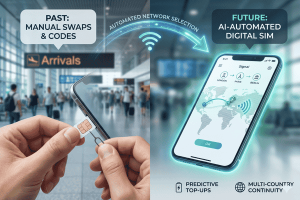
This is where the type of internet connection you use becomes critical. When you use a local Chinese SIM card or connect to most public Wi-Fi networks, your internet traffic is routed through domestic servers. This means your connection is subject to the full force of the Great Firewall. However, some international roaming solutions, including many travel eSIMs, operate differently. They often route your data through servers located outside of mainland China. This process, known as international roaming, effectively places your internet connection beyond the reach of the firewall’s restrictions. This is a crucial distinction that can completely change your connectivity experience as a tourist.


A Practical Guide to Using Your eSIM Shanghai
Navigating connectivity in China doesn’t have to be complicated. With the right eSIM Shanghai plan, you can enjoy unrestricted internet access from the moment you land. The key is to choose a provider that offers true international roaming, allowing your data to bypass the Great Firewall. Here’s a step-by-step guide to ensure you’re prepared.
1. Check Your Device Compatibility
Before anything else, confirm that your smartphone is eSIM compatible. Most flagship phones from Apple, Samsung, and Google released in the last few years support eSIM technology. You can usually find this information in your phone’s settings under “Cellular” or “Mobile Network.” Make sure your phone is also unlocked, as a carrier-locked device will not accept an eSIM from another provider.
2. Choose the Right eSIM Plan Before You Travel
The most important step is selecting an eSIM plan designed for travelers to China. Look for providers that explicitly state their service includes access to blocked apps. This is a strong indicator that the data is routed internationally. Providers like Terminal eSIM offer specific plans for China that are built to bypass the firewall, giving you the freedom to use the internet just like you do at home. Purchase your plan a few days before your departure to have everything ready.
3. Install Your eSIM
Once you purchase your plan, you’ll receive a QR code via email. Installing it is simple:
- Go to your phone’s settings.
- Select “Cellular” or “Mobile Data.”
- Tap “Add eSIM” or “Add Cellular Plan.”
- Scan the QR code provided by your eSIM provider.
- Follow the on-screen prompts to label your new eSIM (e.g., “China Travel”).
It’s best to install the eSIM before you leave home while you have a stable internet connection, but don’t activate it for data roaming until you arrive in China.
4. Activate Upon Arrival
When your plane lands in Shanghai, it’s time to activate your travel eSIM.
- Go back to your phone’s cellular settings.
- Turn on your new eSIM line.
- Ensure “Data Roaming” is enabled for this specific eSIM.
- Turn off your primary SIM card or set it to voice/text only to avoid accidental roaming charges from your home carrier.
Within minutes, your phone should connect to a local network partner. You can now open your favorite apps like Google Maps or Instagram to confirm you have unrestricted access. An eSIM Shanghai with firewall-bypassing capabilities is the modern traveler’s best tool for a stress-free trip.
Comparing Connectivity Options for Shanghai
When planning your trip, you have several options for staying connected. Each comes with its own set of benefits and drawbacks, especially concerning the Great Firewall. A travel eSIM that offers unrestricted access stands out, but it’s helpful to see how it compares to other common methods.
| Feature | Travel eSIM (with Firewall Bypass) | Local Chinese SIM Card | VPN with Local SIM/Wi-Fi |
| Firewall Bypass | Yes, data is routed internationally | No, subject to all restrictions | Yes, but can be unreliable |
| Access to Apps | Full access (Google, Instagram, etc.) | Blocked without a VPN | Full access when VPN is active |
| Setup Process | Instant digital setup before travel | In-person purchase with passport | Software installation; requires pre-trip setup |
| Convenience | Activate upon landing, no physical swap | Must find a store and register | Requires connecting VPN each time |
| Reliability | Very high; designed for this purpose | High (for local apps), none (for blocked apps) | Variable; government actively blocks VPNs |
| Cost | Varies by data plan, often cost-effective | Generally cheap for local data | Requires a paid VPN subscription + data cost |
| Phone Number | Data-only or may come with a number | Provides a local Chinese number | Uses existing numbers for calls/texts |
The comparison table highlights a clear advantage for travelers who prioritize convenience and unrestricted internet access. A travel eSIM, like those offered by Terminal eSIM, is specifically designed to solve the firewall problem seamlessly. While a local SIM card is cheap, it locks you into the restricted Chinese internet, making navigation and communication with the outside world difficult.
Using a VPN is a popular workaround, but its reliability in China is increasingly uncertain. The government actively works to block VPN services, and even the most robust VPNs can experience downtime or slow speeds, leaving you disconnected at inconvenient times. For a tourist who needs dependable access to maps, translation apps, and social media, a travel eSIM that bypasses the firewall by design is the most reliable and hassle-free solution. It combines the ease of modern technology with the freedom of an open internet.
Common Traveler Concerns and FAQs
Traveling to a new country always comes with questions, and connectivity in China is a major topic of concern. The interplay between an eSIM Shanghai plan and the Great Firewall can seem complex, but it’s straightforward once you understand the core mechanics. Here, we address some of the most common questions and problems travelers face.
The Problem: Needing a VPN vs. Not Needing One
Many travelers read online that a VPN (Virtual Private Network) is essential for China. A VPN encrypts your internet connection and routes it through a server in another country, which does bypass the firewall. However, this solution has become less reliable over time. The Chinese government has cracked down on VPN services, and many find their chosen VPN is slow, unstable, or completely blocked upon arrival. This can be a major issue if you’re counting on it for navigation or communication.
The Solution: An Integrated Roaming eSIM
A high-quality travel eSIM for China offers a superior solution. Instead of requiring you to run a separate app, the firewall bypass is built into the service itself. Your data is automatically routed through servers outside of mainland China. This means you don’t need to install, configure, or even think about a VPN. You simply activate your eSIM, and your phone works just as it would in Europe or North America, with full access to all your apps. It’s a single-step, integrated solution that removes the uncertainty and technical hassle of using a separate VPN.
Frequently Asked Questions (FAQs)
- Will I be able to use WhatsApp and Instagram with a travel eSIM in Shanghai?
Yes, if you choose a travel eSIM from a provider like Terminal eSIM that is specifically designed for international visitors. These eSIMs route your data through international networks, so you can use WhatsApp, Instagram, Google, Facebook, and other blocked apps freely without needing a VPN. - Is it legal to use an eSIM that bypasses the Great Firewall?
Using an international roaming eSIM is perfectly legal for tourists. The firewall regulations are primarily aimed at Chinese citizens and domestic internet providers. As a foreign traveler using a legitimate roaming service, you are simply using the internet connection provided by your international carrier, which is not subject to the same local restrictions. - What happens if I use public Wi-Fi at my hotel or a café?
If you connect to local Wi-Fi in Shanghai, your connection will be behind the Great Firewall. You will not be able to access blocked sites or apps on that network unless you also use a VPN. This is why having a dedicated travel eSIM is so valuable—it provides you with your own bubble of unrestricted internet wherever you go. - Can I get a local Chinese number with my eSIM?
Most travel eSIMs for China are data-only, as they are designed for internet access rather than local calls. This is usually sufficient for modern travelers who rely on apps like WhatsApp, FaceTime, or Skype for communication. If you require a local number for calls and texts, you would need to purchase a physical local SIM card, but remember that its data will be restricted.
Summary: Your Key to Unrestricted Connectivity
Navigating the digital landscape of China requires a bit of forethought, but staying connected doesn’t have to be a challenge. The Great Firewall restricts access to many essential international apps and websites, a reality that can significantly impact a traveler’s experience. Relying on local Wi-Fi or a domestic Chinese SIM card means you will be subject to these limitations, making simple tasks like looking up directions on Google Maps or sharing photos on Instagram impossible without a separate, and often unreliable, VPN.
A far more elegant and effective solution is a travel eSIM specifically designed for China. By choosing a provider that routes your data traffic through international servers, you completely bypass the Great Firewall. This integrated approach means you land in Shanghai, activate your eSIM, and immediately have the open, unrestricted internet you’re used to. There’s no need to fuss with VPN apps or worry about service disruptions.
This guide has walked through what the firewall is, how different connectivity options stack up, and the practical steps for using an eSIM Shanghai plan. The conclusion is clear: for the modern traveler who values convenience, reliability, and digital freedom, a dedicated travel eSIM is the superior choice. It empowers you to explore, communicate, and share your journey without boundaries.
Stay Connected in Shanghai with Terminal eSIM
Your trip to Shanghai should be about soaking in the culture, tasting new foods, and making lasting memories—not worrying about your internet connection. With a travel eSIM from Terminal eSIM, you can leave connectivity concerns behind. Our eSIMs for China are designed to give you a seamless, unrestricted online experience from the moment you arrive. Forget about unreliable VPNs or the hassle of finding a local SIM card. Our solution gives you immediate access to all your favorite apps, including Google Maps, WhatsApp, and Instagram, right out of the box.
For digital nomads who need to work, families who want to stay in touch, or solo adventurers who rely on their phone for navigation, a reliable connection is non-negotiable. Terminal eSIM provides fast, secure, and open internet access tailored for the international traveler. Our easy-to-install eSIMs ensure you’re connected in minutes, so you can focus on what truly matters: your journey.
Ready to experience China without digital walls? Explore our affordable and powerful eSIM plans for your trip to Shanghai today.