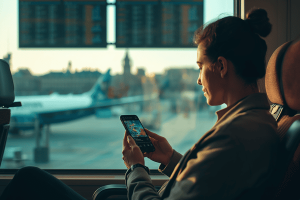
However, for many travelers, the post-vacation high is often crushed by a “bill shock”—a staggering invoice from their mobile provider that costs more than the flight itself.
Traditional international phone plans offered by major domestic carriers are notorious for their convenience but often come with a heavy price tag. Whether it’s a flat $12 daily fee or exorbitant “pay-per-use” rates that can reach over $2,000 per gigabyte, the costs are designed to catch you off guard. But it doesn’t have to be this way.
In 2026, staying connected abroad has evolved. You no longer need to be at the mercy of your home carrier’s expensive roaming tiers. By understanding the mechanics of travel data and leveraging new technologies like eSIMs, you can enjoy seamless connectivity for a fraction of the cost. Ready to stop overpaying? Let’s dive into the secrets of smarter, cheaper travel data.
1. The Reality of International Phone Plans: Why You’re Paying Too Much
To understand how to save, we first need to look at why international phone plans are so expensive. Most people stick with their home provider because it’s easy. You land, turn off airplane mode, and—voila—you have bars. But that convenience is essentially a premium service with a massive markup.
The “Day Pass” Trap
Most major US and UK carriers offer a “Day Pass” or “Travel Pass.” In 2026, these typically cost between $10 and $15 per day. While that might sound reasonable for a weekend getaway, a two-week honeymoon can quickly add $210 to your bill. Furthermore, these plans often “throttle” your speeds after a certain amount of usage, leaving you with painfully slow 2G speeds just when you need to call an Uber.
Pay-Per-Use: The Silent Budget Killer
If you don’t opt into a specific plan, you fall into the “pay-per-use” category. This is where the real danger lies. Carriers often charge upwards of $2.05 per MB. To put that in perspective:
- Sending a high-res photo on WhatsApp: ~$6.00
- Streaming 10 minutes of YouTube: ~$80.00
- Background app refreshes (per day): ~$100.00+
The “Wholesale” Markup
When you roam, your home carrier has to pay a local network in your destination country to use their towers. Your carrier negotiates these rates at a wholesale level but then passes the cost onto you with a significant profit margin attached. You aren’t just paying for the data; you’re paying for the administrative bridge between two giant corporations.
Why It’s Changing
The rise of the digital nomad and the post-pandemic travel boom has forced the industry to modernize. Users now demand transparent pricing and high-speed 5G access without the corporate “middleman” fees. This shift has paved the way for independent providers and eSIM technology to disrupt the traditional roaming model.
2. 5 Secrets to Slashing Your Travel Data Costs
If you want to bypass the high costs of traditional international phone plans, you need a strategy. Here are five actionable secrets to keep your data fast and your budget intact.
Secret 1: Embrace the Power of eSIMs
The single most effective way to save is by using an eSIM (embedded SIM). Unlike a physical card, an eSIM is a digital profile you download to your phone. It allows you to connect to local networks at local rates without ever stepping into a store.
- How it works: You purchase a plan from a provider like Terminal eSIM, scan a QR code, and activate it the moment you land.
- The benefit: You can keep your primary number active for emergency texts while using the eSIM for all your data-heavy tasks.
Secret 2: Audit Your “Background Data”
Even with a cheaper plan, you don’t want to waste data. Modern smartphones are “leaky”—they download updates and sync photos in the background.
- Turn off Background App Refresh: Go to settings and restrict apps from using data unless they are open.
- Disable “Wi-Fi Assist” (iOS) or “Network Acceleration” (Android): These features use cellular data to “boost” weak Wi-Fi signals, often without you realizing it.
Secret 3: Download Maps for Offline Use
Navigation is usually the #1 data consumer for travelers. Before you leave your hotel’s Wi-Fi, download the offline area on Google Maps. You’ll still get GPS functionality and turn-by-turn directions without using a single kilobyte of cellular data.
Secret 4: Use Low-Data Modes in Social Apps
Apps like Instagram, TikTok, and YouTube are designed to consume as much bandwidth as possible to provide high-quality video.
- Settings > Data Usage: Most social apps have a “Data Saver” mode that prevents videos from auto-playing and reduces image resolution. This can cut your data consumption by up to 50%.
Secret 5: Check for “Regional” vs. “Global” Plans
If you are visiting multiple countries (e.g., a backpacking trip through Southeast Asia or a European rail tour), don’t buy individual country plans. Look for regional eSIM packages. A “Europe 30-Country” plan is almost always cheaper and more convenient than buying separate SIMs for France, Italy, and Germany.
3. Comparing the Best Ways to Stay Connected
To visualize the savings, let’s look at how different connectivity options stack up for a typical 10-day trip to Europe or Asia using approximately 5GB of data.
| Feature | Home Carrier Roaming | Local Physical SIM | Travel eSIM (e.g., Terminal eSIM) |
| Typical Cost | $100 – $150 | $20 – $40 | $15 – $30 |
| Setup Effort | Zero (Automatic) | High (Find store, ID check) | Low (Digital download) |
| Keeps Home No. | Yes | No (Must swap cards) | Yes (Dual SIM mode) |
| Data Speed | Throttled after 2GB | High Speed | High Speed (5G/4G) |
| Hidden Fees | High (Taxes/Surcharges) | Low | None |
| Best For | Business travelers | Long stays (1 month+) | Short trips & nomads |
Key Insights from the Comparison
The data is clear: while roaming is the easiest “set and forget” method, it is financially the least efficient. Physical SIMs offer great value but come with the “vacation tax” of lost time—spending your first hour in a new city hunting for a kiosk and fumbling with a SIM tool is nobody’s idea of fun. The international phone plans provided by eSIM services offer the “Goldilocks” solution: the convenience of roaming with the price point of a local SIM.
4. 2026 Trends and Frequently Asked Questions
As we move through 2026, the landscape of travel technology continues to shift. One major trend is the “eSIM-only” smartphone. Since the release of recent flagship models, many manufacturers have removed the physical SIM tray entirely. This move has made digital-first connectivity the global standard.
Another trend is the rise of Unlimited Data eSIMs. Travelers no longer want to count megabytes; they want the freedom to stream and share without anxiety. Providers are now offering “unlimited” tiers that are still significantly cheaper than the daily roaming passes of old.
Frequently Asked Questions (FAQs)
Q: Will an eSIM work on my specific phone?
A: Most smartphones released after 2020 (iPhone 11 and newer, Samsung S20 and newer, Pixel 3 and newer) are eSIM compatible. You can check by looking for an “EID” number in your device’s “About” settings.
Q: Can I still receive calls on my regular number while using a travel eSIM?
A: Yes! This is the beauty of Dual SIM technology. You can set your home SIM to “On” for calls and texts (to receive 2FA codes or important calls) while setting your travel eSIM as the primary source for “Cellular Data.”
Q: Does my phone need to be unlocked?
A: Yes. For any third-party international phone plans to work, your device must be carrier-unlocked. If you are still paying off your phone through a contract, contact your carrier to see if they can provide a temporary or permanent travel unlock.
Q: Is 5G available on travel eSIMs?
A: In 2026, most premium eSIM providers offer 5G access in major metropolitan areas globally. However, in more rural or developing regions, the connection may default to 4G/LTE.
5. Summary: Taking Control of Your Connection
Staying connected while traveling shouldn’t feel like a luxury, and it certainly shouldn’t break your bank. We’ve explored the hidden traps of traditional international phone plans, from the deceptive “Day Pass” to the astronomical costs of pay-per-use data.
By utilizing secrets like downloading offline maps, auditing your background data, and—most importantly—switching to an eSIM, you can reclaim your travel budget. The shift from physical to digital connectivity is not just a trend; it’s a permanent change in how we navigate the world. Whether you’re a casual vacationer or a professional digital nomad, the tools to avoid “bill shock” are already in your pocket.
6. Experience Smarter Travel with Terminal eSIM
Why settle for overpriced roaming when you can have world-class connectivity at your fingertips? At Terminal eSIM, we believe that travel should be about the destination, not the data bill. Our plans are designed by travelers, for travelers, ensuring you get high-speed access in over 190 countries without the “carrier tax.”
With Terminal eSIM, you get:
- Instant Activation: Buy, scan, and connect in under two minutes.
- Transparent Pricing: No hidden fees, no “activation” surcharges, and no surprise bills when you get home.
- 5G Connectivity: Experience the fastest networks available in your destination.
- Flexible Packages: From 1GB for a quick weekend to 20GB for a cross-continental trek.
Don’t let your home carrier dictate your travel budget. Take the first step toward stress-free, affordable connectivity today.